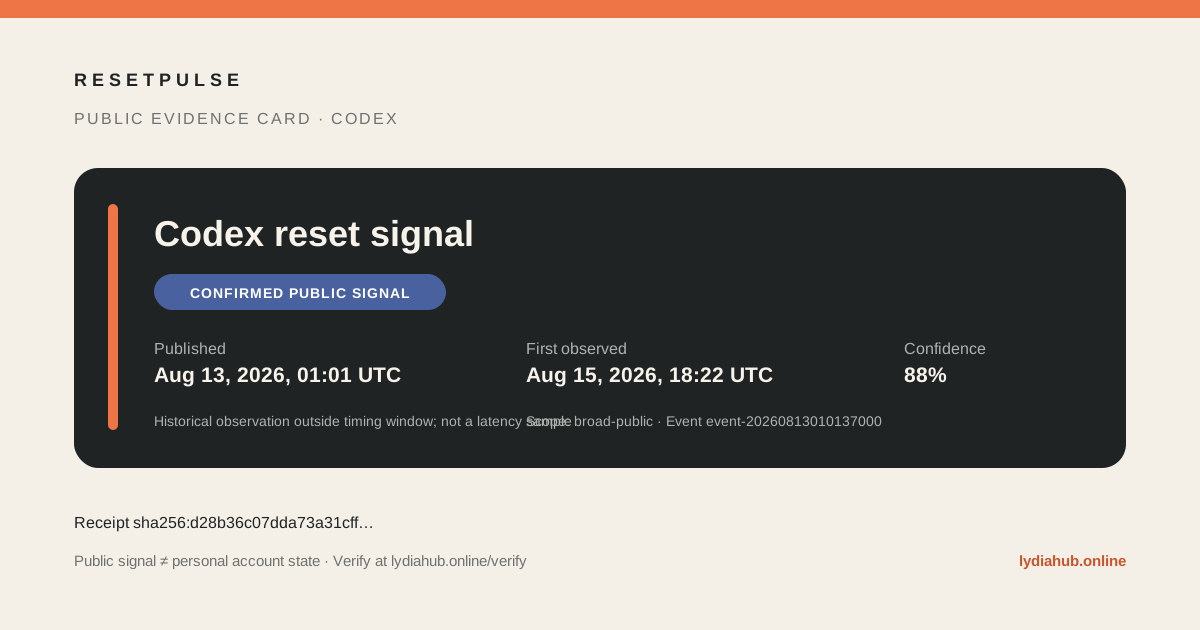
ResetPulse is easiest to trust when the useful explanation travels with the evidence. This kit turns the product advantage into platform-native drafts: answer first, share one relevant proof path, and keep public signals separate from private account state.
The shareable product surface
One event. One receipt. One reason to click.
Competitors can publish a screenshot or a countdown. ResetPulse can attach a human-readable evidence card to a machine-readable record, with source time, observation time, scope, event type, and a local verification path. The evidence clock stays in UTC while readers can view the timeline in their browser's local time.
One fetch creates a current English update from the public packet. It keeps source time, first observation, scope, and event type visible; it never reads an account or turns a public signal into a personal verdict.
Loading the current public signal…
Share Gate: closed · refresh until the public packet is fresh. A fresh packet reduces stale-link sharing; it does not prove a private account reset.
Copy a context-specific draft
These are starting points, not a posting schedule. Adapt the wording to the thread, include only one relevant link, and stop if the community does not want promotion.
Answer-first reply
Use this without a link when someone is asking about a reset, a weekly window, or a conflicting account report. Add your own concrete explanation first.
The key distinction is the public reset signal versus your account's own quota window. A public announcement can arrive before or after a specific plan changes. I would record the source time, the first time it was observed, and the scope before treating it as a universal reset.
Reddit: answer-first evidence
Use only in a thread that already asks about Codex reset timing. Give the direct answer first, keep one proof path, and do not ask for votes or follows.
Short answer: the public signal is not the same thing as your private account window. I would check the source timestamp, first-observed timestamp, stated scope, and receipt before calling it a universal reset. If useful, this live record keeps those clocks separate and links to the underlying proof: https://lydiahub.online/did-codex-reset-today?utm_source=community&utm_medium=share&utm_campaign=evidence_first
Reddit: linkless native reply
Use as the first step when a community is sensitive to outbound links. Answer the concrete question in the thread, omit the URL, and share a proof path only if someone asks for it.
The important distinction is the public reset signal versus the account's own quota window. Business or Work, Personal, and Plus reports can disagree because the plan context and window type differ. I would record the exact limit label, before-and-after allowance, displayed next-reset time in UTC, and the time it was observed before treating the result as universal.
Usage + reset answer
Use when someone asks for usage percentage and reset time in one view. Keep the account data local and explain the public/private boundary before sharing the private-check path.
The useful view is remaining usage % beside the reset time, but a public reset announcement and one account's quota window are separate. You can compare both locally without sharing a login: https://lydiahub.online/account-snapshot?utm_source=community&utm_medium=share&utm_campaign=usage_reset_bridge
X: compact evidence update
Use for a genuine new signal or a meaningful evidence correction. Keep it short, link once, and avoid repeating it when the public signal version has not changed.
New public Codex evidence: source time and first-observed time are recorded separately, with scope and event type kept explicit. That is evidence about the public signal—not a promise about every account. Verify the record: https://lydiahub.online/did-codex-reset-today?utm_source=community&utm_medium=share&utm_campaign=evidence_first
Hacker News: technical launch
Use as a substantive Show HN or technical discussion draft. Lead with the data-contract problem, implementation details, and one feedback question—not growth claims.
Show HN: ResetPulse — a verifiable public evidence layer for Codex reset signals

I built a small read-only monitor for the gap between a public reset announcement and an individual account result. Each public event keeps source time, first observation, confirmation state, claim scope, event type, and a SHA-256 receipt separate. The packet is available as JSON/RSS, with browser verification, ETag polling, and user-owned notification workflows. No login or private quota data is required.

I am looking for feedback on the evidence contract and on which fields a developer would require before using a public signal in an automation: https://lydiahub.online/integrate?utm_source=developer&utm_medium=share&utm_campaign=evidence_first
Three-clock update
Use for a concise status post or comment. Fill in the two UTC times from the public record and leave the account result explicitly separate.
Public signal: [confirmed or early signal]
Source published: [UTC]
First observed: [UTC or pending]
Account result: not inferred from the public signal.
Verify the record, scope, and receipt before treating it as a personal quota update.
Evidence follow-up
Use only when the thread genuinely benefits from a source-backed public record. Keep one relevant link and do not ask for votes or follows.
I kept the public signal and the personal account check separate. The live record shows UTC source and observation times, scope, event type, and a receipt that can be verified locally: https://lydiahub.online/did-codex-reset-today?utm_source=community&utm_medium=share&utm_campaign=evidence_first
Verification reply
Use when someone questions whether the record changed or wants to reproduce the check. This is a proof path, not a claim that every account reset.
You can verify the published record in the browser with its SHA-256 receipt. A matching hash proves record integrity, not private account state: https://lydiahub.online/verify?receipt=%2Fapi%2Fevidence%2Flatest&utm_source=community&utm_medium=share&utm_campaign=evidence_first
Consensus check
Use in a technical comparison when public dashboards disagree. Share the count and disagreement boundary, not a claim that the majority is official.
Different public trackers can expose different states. This comparison counts only available sources with explicit states, shows how many agree, and keeps the minority visible instead of calling a majority an official verdict: https://lydiahub.online/benchmark?utm_source=community&utm_medium=share&utm_campaign=consensus_check
Developer share
Use in a relevant README, issue, or automation discussion. It leads to the read-only packet, RSS, badge, schema, and user-owned notification recipes.
If you need a credential-free public signal rather than a private quota reader, the integration guide has a one-fetch verified packet, schemas, RSS, badge, and user-owned notification workflow: https://lydiahub.online/integrate?utm_source=developer&utm_medium=share&utm_campaign=evidence_first
Redacted outcome share
Use after a local before-and-after check when someone asks whether a public signal reached an account. Share the redacted result, never raw quota data.
I kept the public announcement separate from my account result. I compared sanitized before-and-after snapshots locally and shared only the redacted change; one account is not proof of a global rollout. Method: https://lydiahub.online/account-outcome-check?utm_source=community&utm_medium=share&utm_campaign=redacted_outcome
Zero-login companion share
Use when someone wants background alerts but does not want to grant a site access to Codex cookies or private quota data.
For a low-trust setup, this browser companion checks the public evidence packet locally and can parse a sanitized usage snapshot in memory. It does not read a Codex login or upload quota data: https://lydiahub.online/extension?utm_source=community&utm_medium=share&utm_campaign=browser_companion
Private decision share
Use when someone asks whether to wait, conserve usage, or consider a banked reset. It gives planning help without requesting a login or presenting a public signal as a personal result.
If you are deciding whether to wait or use a banked reset, this browser-only helper weighs your own inputs locally. It does not upload account data, and public evidence is not private account state: https://lydiahub.online/account-decision?utm_source=community&utm_medium=share&utm_campaign=local_decision
Time-zone clarity share
Use when people compare reset times from different regions. Keep the portable proof in UTC while letting each reader view the timeline in their browser's local time.
The comparison is easiest when the evidence clock stays in UTC and the reading view follows each person's local time. That keeps a shared record reproducible without forcing everyone to mentally convert a timestamp: https://lydiahub.online/what-time-does-codex-reset?utm_source=community&utm_medium=share&utm_campaign=timezone_clarity
Weekly project intro
Use in a community's designated self-promotion thread. It answers what you built, the problem, the tools, who it is for, and the feedback you want before giving one link.
I built ResetPulse for Codex users who need to distinguish a public reset signal from what their own account actually shows. It monitors public signals, keeps source time and first-observed time separate, and publishes a verifiable evidence receipt. The new browser-only decision helper weighs remaining usage, urgency, and banked-reset availability without uploading account data. It is for people who want a checkable public record and a private planning aid, not a replacement for the Codex account surface. I would especially value feedback on whether the evidence boundary and recommendations are clear when an account and public signal disagree: https://lydiahub.online/account-decision?utm_source=community&utm_medium=share&utm_campaign=local_decision
LinkedIn technical post
Use for a substantive developer update after a meaningful release. Lead with the account-versus-public-signal problem, show the evidence contract, and ask one concrete implementation question.
A public Codex reset announcement and a private account limit are not the same observation. I built ResetPulse as a small evidence layer for that gap: source time and first observation stay separate, early signals do not become confirmations, and every public event has a verifiable receipt. The read-only packet, RSS, schema, and widget are designed for dashboards and agents; no Codex login, cookies, or personal quota data are required. I am looking for feedback from developers building quota dashboards: which field would you need before trusting an external reset signal? https://lydiahub.online/integrate?utm_source=linkedin&utm_medium=social&utm_campaign=developer_evidence_v1
The operating rule
01
Answer the current question
Explain the difference between a public announcement, a personal window, and an account observation. A useful reply can stand on its own without a link.
02
Use a linkless first step when needed
Some communities treat an unsolicited outbound link as a trust or moderation signal. Start with a complete native answer; only add one relevant proof path when the thread invites it or someone asks for evidence.
03
Give one proof path
When a link is relevant, choose the event page, receipt verifier, or integration guide. Do not paste the same URL across unrelated threads or duplicate the same comment.
04
Let evidence earn the next click
Use the evidence card and verification page to show what is known. Never promise instant delivery, a universal reset, or access to private quota data.
Why this is our promotion advantage
Useful before branded
The first interaction can be a genuinely helpful explanation. The product name appears only when the evidence path adds value.
Proof travels with the claim
A card, receipt, schema, and source link are stronger than a generic daily graphic because a reader can inspect the record instead of trusting a caption.
One source of truth
Community posts, README badges, dashboards, and alerts can point to the same public packet. That reduces copy drift and makes updates easier to audit.
Privacy is visible
The public monitor never asks for a Codex login. Personal checks remain local, and a public reset signal is never presented as private account telemetry.
Do not use this kit for repetitive promotion.
Do not copy competitor images, imply an OpenAI relationship, ask for votes or follows, switch accounts to bypass moderation, or post a link where it does not answer the question. The advantage is credibility built through relevant evidence.