See how the monitor is doing.
A one-minute check cadence is only useful when the collection boundary is visible. This page separates collector freshness from source-content freshness, then exposes the timing measurements and limits behind the public signal.
Loading
The latest collection state is not yet available.
Independent server-side checks; your computer can be offline.
Age: —s. This is collection freshness, not source-change latency.
— public items parsed in —ms.
— accepted claims parsed in —ms.
A separate official public-account lane is shown as corroboration only; an empty claim set is not evidence that no reset exists.— qualifying reset claims parsed in —ms.
The direct public interpretation is not recorded yet. Last direct check: Not recorded. Raw source content is not published.— qualifying reset claims parsed in —ms.
The parallel relay state is not recorded yet. Last relay check: Not recorded. This lane is not independent proof.Newest accepted source item: Not recorded.
This is separate from the collector's last successful check.—ms fetch · — qualifying lanes.
A qualifying lane returned at least one accepted public item; this does not claim delivery latency.— corroborating · — context · no private telemetry.
Secondary public claims are saved after the primary lane finishes, without delaying the first signal.
Latest source time: Not recorded. Latest observation: Not recorded.— independently verified · — community/corroborating.
Same-origin relays and unverified reports remain visible without upgrading the evidence state.— baseline · — total source fingerprints.
A baseline is not a latency claim; measured rows require a new eligible source timestamp pair.Confirmation and confirmed-reset alerts share the guarded delivery path.
Runtime configuration is not available yet.Median Pending sample · p95 Pending sample · latest Pending sample.
Timing is recorded only when a new primary event has an explicit source time and first-observed time. Window: —s. Excluded: —.No accepted source-set change has been recorded in the current window.
A semantic fingerprint is kept private; only the public change result is exposed.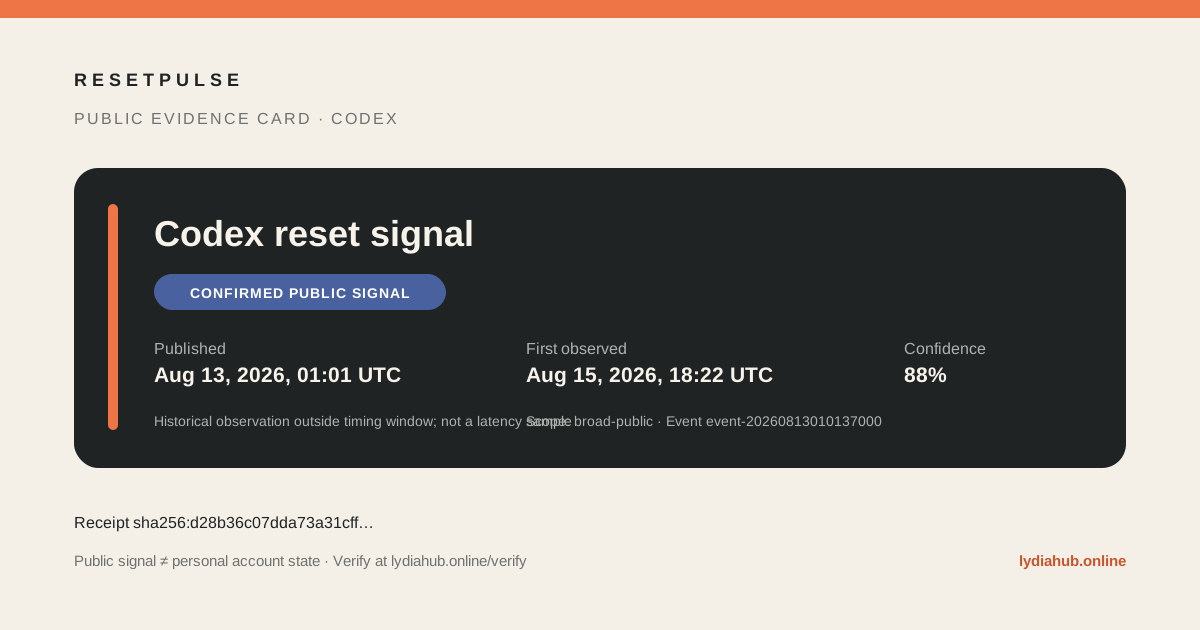
What the receipt can prove
It can show that the collector is reachable, when its last successful check completed, what public items were parsed, and whether any accepted primary event has a recorded source-to-observation interval. It cannot prove that every Codex account changed, and a collection check is not a delivery SLA.
Use the same facts in a tool
For a dashboard or automation, use the JSON health receipt, the reliability report, the compact public packet, or the integration guide. The public endpoints are read-only and credential-free.